 NorthClover
Most weekly reviews die in week three. They start as a ritual and slowly turn into a chore: a long checklist, an inbox to empty, a project list to audit. Here is a smaller version that survives. Four questions, fifteen minutes, once a week.
The weekly review was made popular by David Allen’s Getting Things Done, where it is the habit that keeps the whole system trustworthy. The idea is right. The trouble is that most people copy the full version, which can take an hour or more. If a review feels like work, you skip it the first week you are busy, and the busy weeks are exactly when you need it.
So this guide keeps only what matters: an honest look back, one small change and a clear intention for the week ahead.
Why a week is the right size
A day is too short to judge. One bad Tuesday tells you nothing. A month is too long: by the time you look back, you have forgotten what happened in week one, and the lessons arrive too late to use.
A week is the smallest stretch of time where you can compare what you meant to do with what you actually did, and still remember why the two were different. It is also short enough that a fix you choose today gets tested within seven days.
A weekly review isn’t a report card. It’s a steering wheel.
The method
The four questions
Each question does one job. Together they close the loop: what you meant to do, what happened, what got in the way, and what you’ll change.
- IntentionWhat do you wish to achieve this week?
- ShippedWhat did you ship this week?
- AvoidedWhat did you avoid or resist?
- One fixOne thing to fix next week
Then next week’s intention starts the loop again
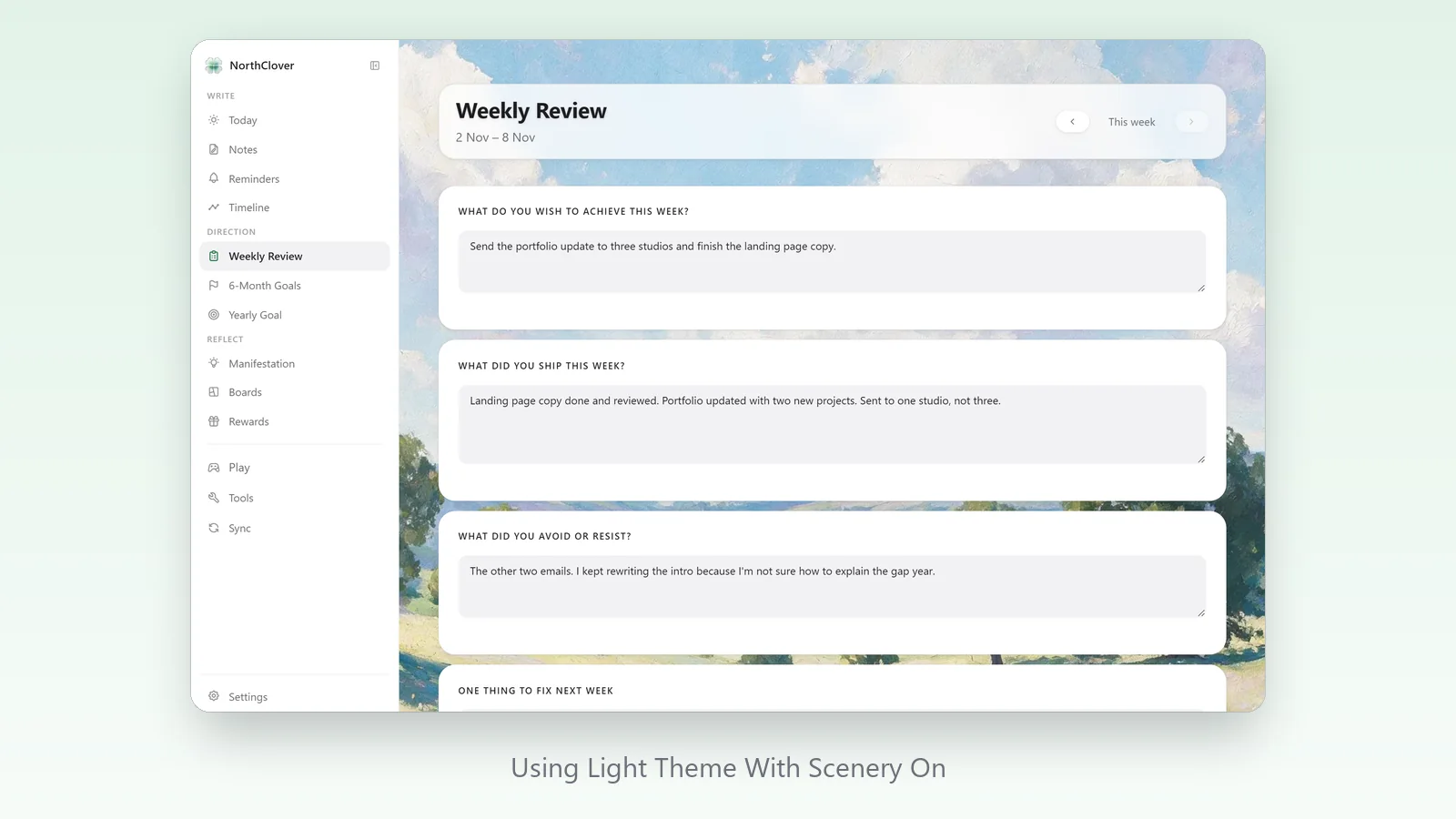
These four questions are the backbone of NorthClover’s Weekly Review. Here is what each one is for.
1. What do you wish to achieve this week?
Set this at the start of the week, before the week starts running you. Not a to-do list. One or two sentences about what would make this week a win. “Finish the first draft of chapter two” works. “Be more productive” doesn’t: you can’t tell on Sunday whether it happened.
2. What did you ship this week?
Write down what actually got done: designs, pages, runs, calls, anything you moved forward. Include the small things. This question exists because memory is unfair. A week where you did a lot can still feel like a week where you did nothing, simply because the last day was messy.
3. What did you avoid or resist?
This is the most useful question and the one people want to skip. The task you kept pushing to tomorrow. The message you didn’t send. The part of the project you quietly stepped around. Name it plainly. You are not confessing, you are collecting data: the things you avoid usually point straight at what is unclear, too big or genuinely unwanted.
4. One thing to fix next week
Just one, and keep it specific and small. “Get up earlier” is a wish. “Phone stays in the kitchen until 9 am” is a fix. One change you actually make beats five you forget by Tuesday.
A review that ends with a list of improvements quietly becomes another backlog. One fix is small enough to remember without writing it on your hand, and next week’s review tells you whether it worked.
The routine
The 15-minute routine
Pick the same time every week. Sunday evening and Monday morning are the most common, but Friday afternoon works well if you like to close the week before the weekend.
Then run it in this order:
- 2 minRe-read last week’s intention.Don’t judge it yet. Just remind yourself what you were aiming for.
- 4 minList what you shipped.Scroll your calendar, your notes or your sent messages if your memory needs help.
- 4 minName what you avoided.One to three things. Add a few words on why, if you know.
- 2 minChoose one fix.Usually it comes straight out of step three.
- 3 minWrite next week’s intention.What would make next week a win? Keep it to one or two sentences.
That’s it. If you finish early, stop. A review that ends early is still a review, and a short one you do every week beats a perfect one you do once a month.
A worked example
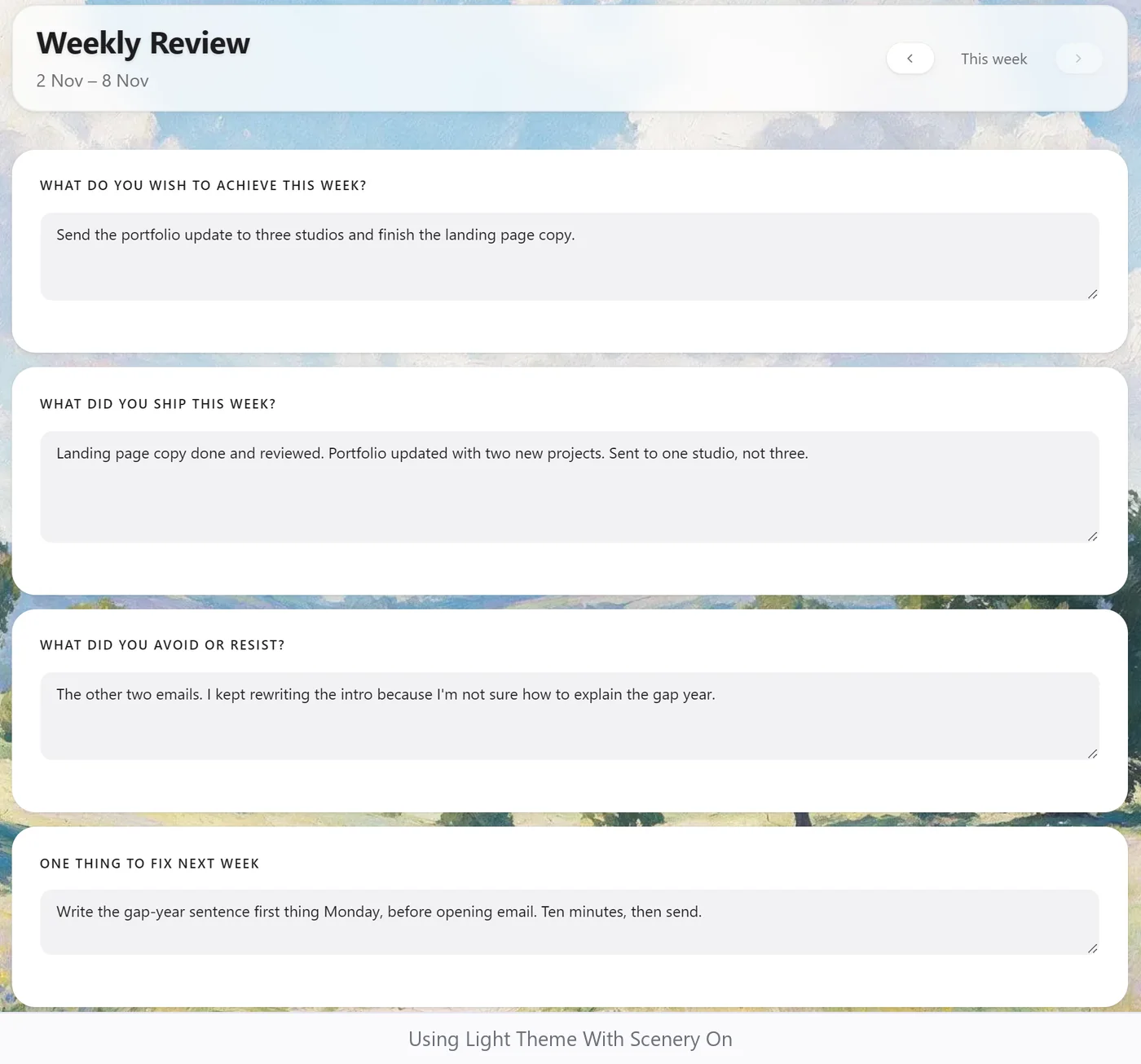
Here is what an honest review can look like for a week that went only half to plan. It’s an example, not a template to copy word for word.
- What did I wish to achieve?
- Send the portfolio update to three studios and finish the landing page copy.
- What did I ship?
- Landing page copy done and reviewed. Portfolio updated with two new projects. Sent to one studio, not three.
- What did I avoid or resist?
- The other two emails. I kept rewriting the intro because I’m not sure how to explain the gap year.
- One thing to fix next week
- Write the gap-year sentence first thing Monday, before opening email. Ten minutes, then send.
Notice what the review did. It didn’t just record a missed goal. It found the real blocker (one awkward sentence) and turned it into a ten-minute task with a time attached. That is the whole point.
Common mistakes that kill the habit
- Turning it into a task audit. Going through every open task takes an hour and teaches you nothing about how the week went. Clear your task list some other time.
- Choosing five fixes. You will remember none of them. Pick one.
- Skipping the bad weeks. A rough week is when the review is most useful. Write “I was sick and shipped nothing” and move on to next week’s intention. That still counts.
- Reviewing in a different place every time. If last week’s review lives in one app and this week’s on a scrap of paper, you lose the most valuable part: reading old reviews side by side and spotting what keeps coming back.
- Grading yourself. Scores and percentages make the review feel like an exam. Plain sentences are enough.
Making it stick
Where to keep your reviews
Paper works. So does a single note you add to every week. What matters is that every review lives in the same place and that you can read the old ones again.
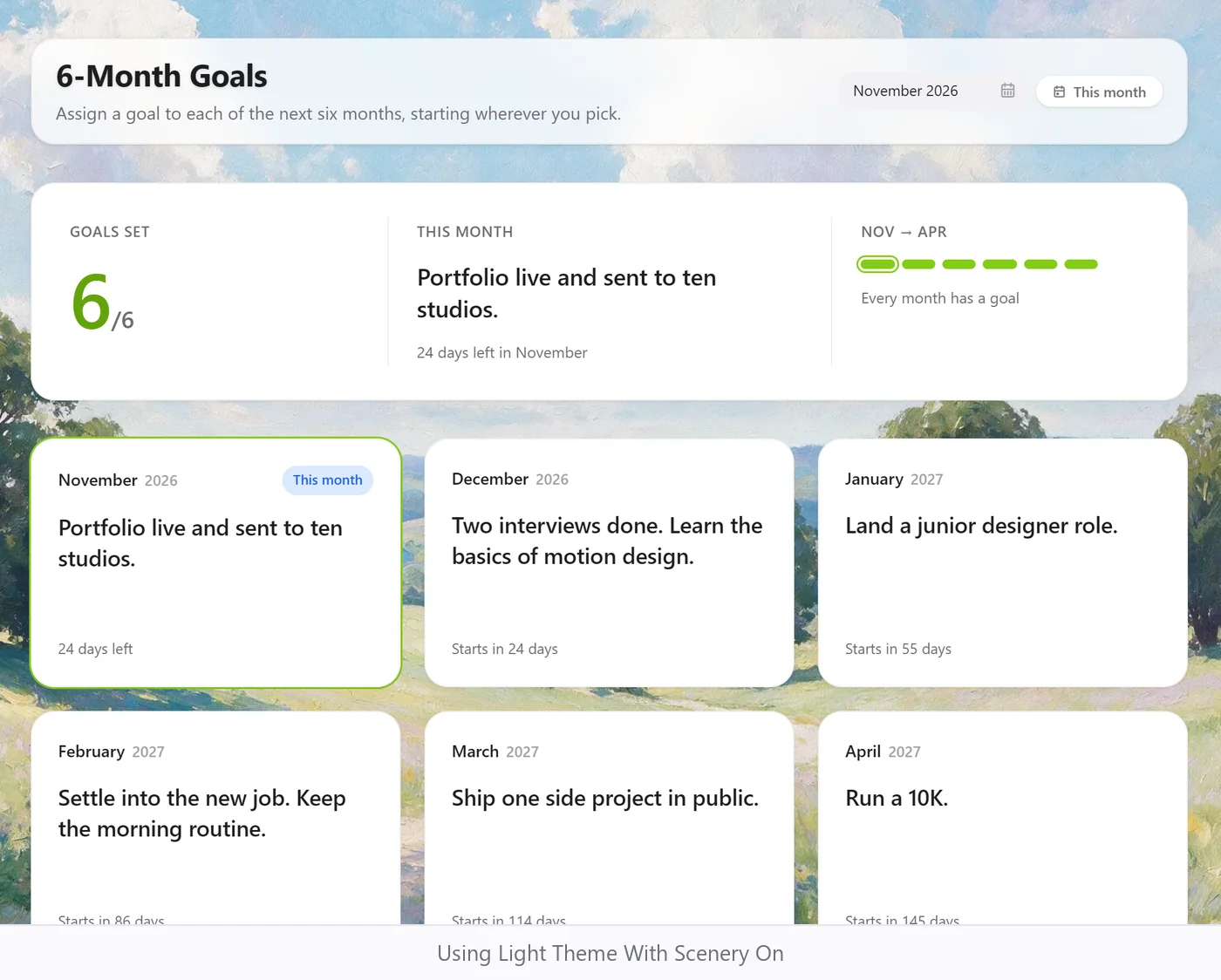
Patterns only show up across several weeks: the same avoided task three weeks in a row is telling you something. Keeping the bigger picture close helps too. A week makes more sense when you can see what the next few months are for.
If you want a place built for this, NorthClover has a Weekly Review built around these four questions, with your past reviews kept alongside so last month is one click away. Your 6-Month Goals and Yearly Goal live in the same app, so the week never drifts far from the bigger picture. It works on Windows, Mac and Android, and everything stays on your own devices: no account, no cloud.
Frequently asked questions
What day is best for a weekly review?
The one you will keep. Sunday evening suits people who like to start Monday with a plan. Friday afternoon suits people who like to close the week before the weekend. Pick one and protect it like an appointment.
How long should a weekly review take?
Ten to twenty minutes is plenty for a personal review. If yours regularly takes an hour, you are probably doing a task audit too. Split it out and keep the review short.
What if I missed a few weeks?
Don’t try to catch up. Do this week’s review as normal and pick up from here. Back-filling old weeks from memory produces fiction, not data.
Is a weekly review the same as journaling?
They work well together but do different jobs. A journal records what happened and how it felt, day by day. A weekly review steps back once a week to compare plans with results and choose what to change. Many people skim their daily entries during the review.